
 Home
Home






Introduction: The Shadow Planets in Vedic Astrology
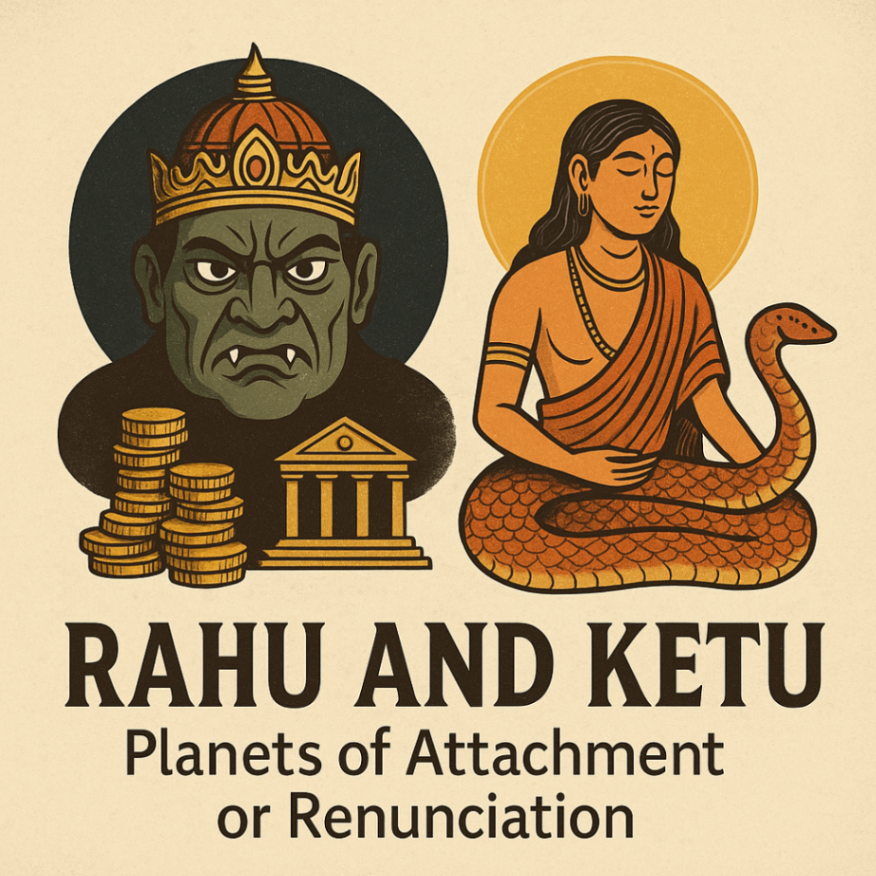
Rahu and Ketu, the shadowy lunar nodes, hold deep karmic significance in Vedic astrology. They are not physical planets but mathematical points, known as the Dragons Head (Rahu) and Dragons Tail (Ketu). Despite their invisibility, they influence major life events, psychology, and spiritual evolution.

They are often misunderstood as purely malefic forces, but their essence lies in duality—while Rahu drives material attachment, Ketu promotes spiritual renunciation.
Let us explore whether they are truly the planets of attachment or renunciation, and how they affect our karmic journey.
Rahu and Ketu in the Scriptures

The original texts by Maharshi Parashara do not describe Rahu and Ketu with physical characteristics. As “blind planets”, they are said to have no light of their own.
Some later interpretations describe Rahu as Saturnian in nature—dark, tall, ugly, and fearsome when influencing the ascendant. But if Rahu is conjoined with Sun or Moon, it can give birth to charismatic and intelligent leaders—like Karl Marx.
Importantly, Rahu and Ketu are not always malefic. In certain signs, especially when well-placed or receiving benefic aspects, they can yield positive and even spiritual results.
Rahu: The Planet of Attachment and Ambition
Rahu rules three powerful nakshatras: Ardra, Swati, and Shatabhisha. It is deeply associated with desire, illusion, and ambition.
When well-placed, Rahu can produce:

Social reformers
Politicians
Inventors and scientists
Media and mass communication experts
But when afflicted, Rahu may cause:
Trickery
Illusions
Addictions
Deceptive behavior
Rahu’s placement shows the direction of one’s karma—where efforts will be invested and often obsessed over.
However, if Rahu is in contact with benefic planets like Jupiter, it can bring out humanitarian and charitable traits. As noted by astrologer H.N. Katwe, Rahu can even become a source of moksha, depending on its alignment.
In Lal Kitab, Rahu is associated with Bhairava, a fierce form of Lord Shiva—symbolizing destruction, transformation, and ultimately liberation through chaos.
Ketu: The Planet of Renunciation and Spiritual Insight
On the other hand, Ketu is the symbol of spiritual detachment, intuition, and past-life mastery. It governs the nakshatras:
Ashvini
Magha
Mula
Ketu is often linked with:
Mysticism
Astrology
Medical sciences
Law and occult sciences
Ketu signifies areas of life where we experience less desire—as we have likely mastered them in past lives. Hence, the native may show detachment toward the house where Ketu is placed.
Key traits of Ketu include:
Spiritual evolution
Psychic abilities
Restlessness
Gyana (wisdom) and Moksha (liberation)
Ketu doesn’t create craving. It operates subtly, pulling one away from worldly attachments toward self-realization.
Karmic Roles of Rahu and Ketu: Past and Present Life
The karmic axis formed by Rahu and Ketu reveals the life lessons of a native.
Rahu represents unfulfilled desires, urging us to move toward material experiences.
Ketu indicates past accomplishments, pushing us toward spiritual detachment.
Their influence becomes especially clear through the 5th and 9th house aspects, symbolizing:
5th House – Past life karma, talents, and accumulated wisdom
9th House – Dharma, life’s purpose, and spiritual direction in the current birth
Thus, Rahu and Ketu together reflect the journey of the soul—from material entanglement (Rahu) to renunciation and spiritual liberation (Ketu).
Common Misconceptions and Their Reality
“Rahu is always bad” – False. A strong Rahu in a favorable sign, or under Jupiter’s influence, can produce visionaries and leaders.
“Ketu causes losses” – Not always. Ketu detaches only from what has been mastered. It may manifest results without effort, especially in spiritual or occult fields.
“Both are malefic” – Context matters. When aligned with dharma, they aid inner transformation.
Rahu and Ketu During Mahadasha and Antardasha
When Rahu or Ketu is active in a Mahadasha or Antardasha, the native may experience:
Rahu period:
Intense desires
Fame or infamy
Technological advancement
Travel and change
Obsession or overindulgence
Ketu period:
Withdrawal from outer world
Sudden separations
Inner contemplation
Vivid dreams or spiritual visions
Remedies and Advice
During Rahu periods, it is advised to:
Visit pilgrimage sites
Engage in Satsang (holy company)
Worship with sincerity
Practice grounding techniques like pranayama
During Ketu periods:
Embrace meditation
Spend time in solitude
Study spiritual texts
Help others selflessly
By consciously working with their energies, these shadow planets can bring immense spiritual transformation.
Conclusion: The Dual Path of Evolution
Rahu and Ketu: Planets of Attachment or Renunciation—this duality is not a contradiction, but a cosmic design.
Rahu binds us to the material realm so we may learn through experience. Ketu unbinds us, guiding the soul toward freedom and wisdom.
Both are essential for evolution—one pulls, the other releases. Together, they represent the soul’s journey from earthly desires to divine realization.
 Comment
 Write with AI






















 Download App